Picture this. A guest checks into a hotel, and a chatbot handles the booking flawlessly in under a minute. However, no algorithm on the planet can read that emotional cue the way a qualified hospitality professional can when that same guest arrives exhausted, irritated after a delayed flight, and a little homesick.
Artificial intelligence is reshaping guest personalization, hotel operations, revenue optimization, and intelligent decision-making at a pace nobody predicted five years ago. Yet human intelligence still defines empathy, emotional connection, creativity, and service excellence. Hospitality management studies must now prepare students to work alongside intelligent technologies rather than compete against them.
Top hospitality education institutions have already started incorporating AI-driven hospitality concepts, data analytics, ethical AI practices, and smart hotel operations into their curricula. This is to prepare graduates for what the industry actually needs, not what it needed ten years ago. Industry-integrated education, AI awareness, practical training, and leadership development together create graduates who thrive in a technology-enabled hospitality landscape rather than fear it.
Technology moves fast, guest expectations move faster, and most colleges are scrambling to keep up. That’s the tension students studying hospitality management studies face today. If you’re a student, parent, or industry professional wondering whether hospitality education still has a future in an AI-driven world, you’re asking the right question. This blog breaks down exactly why the smartest hospitality programs are teaching both machine intelligence and human warmth, and why graduates who master only one will fall behind.
Why Hospitality Education Is Entering the Era of Human and Artificial Intelligence
Hospitality education is evolving fast because the industry it feeds into is evolving faster. A 2026 industry survey found that 71% of hospitality professionals say AI is having a significant or transformative impact on their operations, and 85% plan to allocate at least 5% of their IT budget specifically to AI tools this year. That’s not a niche trend. That’s a full-scale shift happening across front desks, revenue teams, and housekeeping departments simultaneously.
AI-assisted guest engagement, predictive analytics, intelligent reservation systems, automated operations, and digital service ecosystems are becoming standard rather than optional. Yet hospitality remains, at its core, a people’s business. Nobody books a hotel because the Wi-Fi router is charming. They come back because a staff member remembered their name or solved a problem with genuine care.
Hospitality management studies must therefore develop technological competence alongside emotional intelligence, communication, and leadership skills in equal measure. A curriculum that leans too heavily on either side produces graduates who are either technologically fluent but emotionally flat, or warm and welcoming but operationally lost. Modern hospitality education, done right, balances both.
Understanding the Difference Between Human Intelligence and Artificial Intelligence in Hospitality
Here’s the honest breakdown. AI excels at automation, data processing, forecasting, and operational efficiency. It can crunch thousands of booking patterns overnight and spit out a pricing recommendation before the front office manager finishes their coffee. Human professionals, meanwhile, bring empathy, judgement, creativity, cultural sensitivity, and relationship building, qualities no dataset can replicate.
Think about it this way. A machine can flag that a guest has booked the same room five times. A human notices that the same guest always looks stressed at checkout and asks if everything is okay. That small gesture often becomes the reason a guest becomes a loyal customer for life. Future hospitality leaders succeed by integrating both forms of intelligence rather than leaning exclusively on technology or clinging only to traditional operational habits. Hospitality management studies that teach this balance produce graduates who understand when to trust the algorithm and when to trust their gut.
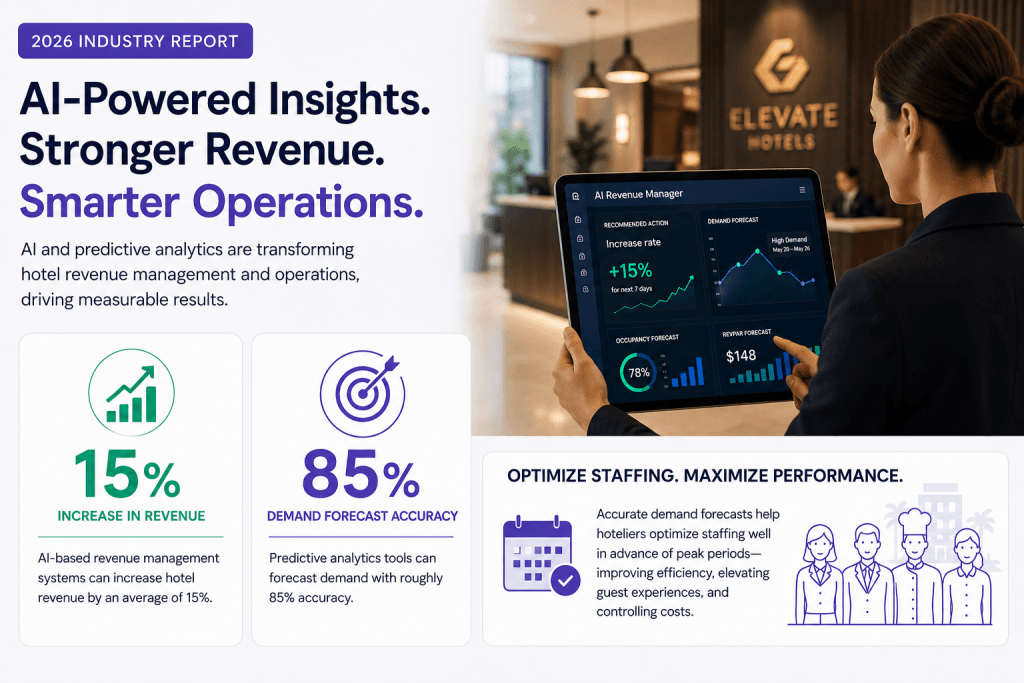
AI is reshaping hotel management through intelligent property management systems, chatbot communication, revenue optimization, demand forecasting, guest personalization, housekeeping automation, and operational analytics. According to a 2026 industry report, AI-based revenue management systems can increase hotel revenue by an average of 15%, and predictive analytics tools can forecast demand with roughly 85% accuracy, helping hoteliers optimize staffing well in advance of peak periods.

AI has genuinely become an essential management tool across hospitality organizations. Hospitality management studies must expose students to these systems, so they graduate with a working understanding of how AI enhances operational efficiency and supports informed managerial decisions.
A student who has actually used a property management system, watched a demand forecasting dashboard update in real time, or analyzed guest sentiment data walks into their first job already ahead of peers who only read about these tools in a textbook.
AI is designed to assist hospitality professionals by improving speed, efficiency, forecasting accuracy, and consistency. It cannot replace authentic guest interaction, emotional intelligence, ethical judgement, or personalized problem solving. A chatbot can answer “what time is checkout” a thousand times a day without complaint. It cannot de-escalate an angry guest whose luggage got misplaced during a family reunion, and it certainly cannot offer a sincere apology that actually feels sincere.
Successful hospitality organizations will increasingly depend on professionals capable of combining AI-powered insights with human-centered change leadership and genuine service excellence. This is where hospitality management studies earn their value. Students who learn to read AI dashboards while also learning conflict resolution and guest psychology become the managers who can act on data without losing the human plot.
Why Human Intelligence Will Always Remain the Heart of Hospitality
Here’s a question worth sitting with: can technology ever fully replace human warmth in hospitality? Based on everything the industry data shows, the answer remains no, and it’s unlikely to change soon. Memorable hospitality experiences continue to depend on professionals who understand people, emotions, and relationships at a level no model currently replicates.
Empathy, communication, cultural sensitivity, conflict resolution, creativity, and guest engagement define outstanding hospitality experiences. A guest celebrating an anniversary doesn’t want an automated congratulations message. They want a staff member who notices, asks a genuine question, and perhaps arranges a small surprise.
AI enhances operational efficiency behind the scenes, but the emotional payoff still comes from human effort. Hospitality management studies must therefore continue strengthening interpersonal competencies alongside technological education, treating soft skills not as a nice-to-have elective but as a core, gradable, practised discipline.
How Institutions Are Preparing Students for AI Enabled Hospitality Careers
Forward-thinking hospitality education now integrates technology with practical, hands-on learning. This includes AI-assisted interview preparation, technology-oriented curriculum enhancements, hospitality software exposure, practical laboratories, internships, and industry collaborations.
Students trained this way graduate confident enough to operate within AI-powered hospitality environments while still holding onto the human values that define successful leadership. What skills should students learn alongside hospitality management studies for the AI era? Students benefit hugely from complementing their core degree with AI literacy, data analytics fundamentals, digital communication skills, hospitality software proficiency, emotional intelligence training, sustainability awareness, leadership development, and structured problem-solving practice.
This multidisciplinary approach significantly strengthens employability, especially since 78% of hotel sales teams already use AI to automate lead qualification, meaning graduates who understand both the software and the strategy behind it stand out immediately.
Practical Learning That Connects Smart Hospitality Technology with Real-World Operations
Internships, simulation-based learning, live hotel projects, and direct industry collaborations let students apply AI concepts within actual hospitality environments rather than hypothetical case studies. Students learn more from working with genuine guest experience platforms, data-driven operational dashboards, and intelligent service systems than they could from a lecture.
A student who spends a semester shadowing a revenue manager, watching AI-driven pricing recommendations play out in real bookings, understands dynamic pricing far better than one who only memorized the formula. Experiential learning bridges the gap between classroom theory and technology-enabled hospitality careers, and it’s often the deciding factor in whether a graduate feels ready on day one of their first job or completely overwhelmed.
Ethics and Responsible AI Should Become Core Components of Hospitality Management Studies
How does AI impact guest privacy in hospitality? It’s a fair concern, and a growing one. AI systems collect enormous volumes of guest data, from booking patterns to in-room preferences to payment details, and responsible handling of that data matters more than ever.
Guest privacy, responsible data usage, algorithmic fairness, transparency, and cybersecurity all deserve serious classroom time, not a passing mention in week twelve. Future hospitality professionals must understand not just how AI functions but how to implement it responsibly without compromising guest trust or organizational integrity.
Data privacy versus personalization tension is already flagged by industry analysts as one of the biggest structural challenges facing hospitality in 2026. Students who graduate with a working understanding of ethical AI deployment will be the ones organizations trust with sensitive guest relationship decisions.
Leadership Skills That Future Hospitality Professionals Must Develop Alongside AI
In AI-enabled hospitality organizations, strategic thinking, flexibility, innovation management, change leadership, teamwork, decision-making, and effective communication are more important than ever.
Someone has to decide which AI recommendation to follow and which to override, and that decision requires judgement, not just data literacy. Hospitality management studies should prepare students to lead multidisciplinary teams where technology and human talent work side by side to improve guest satisfaction and business performance.
A manager who can explain to a nervous housekeeping team why a new automation tool won’t cost them their jobs, while also using that same tool to reduce their physical strain, demonstrates exactly the kind of change leadership the industry desperately needs right now.
How Do Institutions Combine Human Intelligence and Artificial Intelligence in Hospitality Education?
The strongest programs incorporate both technological innovation and human-centric hospitality principles throughout the entire learning journey, not as separate tracks. AI-integrated learning modules sit alongside practical hospitality training, internships, technology-enabled simulations, personality development sessions, and deep industry collaborations.
This combined approach develops graduates capable of using AI strategically while still delivering exceptional guest experiences through empathy, professionalism, and genuine service excellence. It’s not either-or.
A student learns to read a revenue dashboard in one class and practices handling an upset guest in the next, and over time those two skill sets merge into one coherent professional instinct.
The Future of Hospitality Management Studies Will Be Defined by Intelligent Collaboration
Hospitality education will keep evolving alongside automation, predictive analytics, digital guest experiences, and smart hotel ecosystems, and there’s no slowing that trend down. Industry data shows fewer than 10% of hospitality companies currently qualify as fully “AI-scaled” with measurable returns across multiple functions, which means there’s a massive opportunity gap for graduates who understand both the technology and the strategy behind scaling it responsibly.
Educational institutions must continually modernize their curricula to reflect this innovation while preserving the human values that define
hospitality at its best. The institutions willing to invest in this dual approach position their graduates to become future hospitality leaders capable of blending technological innovation with authentic human service, rather than choosing one at the expense of the other.
In a Nutshell
The future of hospitality management studies clearly lies in combining technological capability with human excellence, not choosing between them. AI strengthens operational efficiency, speeds up decision-making, and sharpens forecasting accuracy. Human intelligence remains indispensable for leadership, creativity, empathy, ethical judgement, and the guest relationships that actually build brand loyalty.
Students who develop genuine expertise in both domains will be best positioned to lead the next generation of intelligent, guest-centric, and globally competitive hospitality organizations. The industry isn’t asking students to pick a side. It’s asking them to become fluent in both languages, the language of data and the language of people.
Frequently Asked Questions (FAQs)
1. Is AI going to replace hospitality management jobs?
No. AI automates repetitive tasks like bookings and forecasting, but roles requiring empathy, leadership, and guest engagement remain firmly human, making hybrid skills essential for future hospitality careers.
2. What is the biggest challenge in adopting AI in hospitality?
The gap between awareness and execution. Many hotels use AI in some form, but few have scaled it effectively across hotel operations due to cost, skill gaps, and integration complexity.
3. Do hospitality students need to learn coding for AI literacy?
Not necessarily deep coding, but understanding data analytics, AI tools, and digital platforms significantly improves employability and decision-making confidence in modern hospitality roles.
4. How does AI improve guest personalization in hotels?
AI analyzes booking history, preferences, and behaviour patterns to customize room settings, recommendations, and communication, though genuine emotional connection still requires human staff involvement.
5. Why is emotional intelligence still important in an AI-driven hospitality industry?
Guests remember how staff made them feel, not automated efficiency. Empathy, cultural sensitivity, and genuine care create loyalty that no algorithm can replicate.